
CarbonEthics and PELNI Launches Seagrass Greenhouse Lab for Blue Carbon Resilience
- CarbonEthics

- Feb 27
- 4 min read
Updated: Mar 18

Seagrass plays a vital role in supporting healthy oceans and resilient coastal communities. As a powerful blue carbon ecosystem, it captures and stores carbon, protects the shoreline from erosion, and sustains livelihoods. Recognizing this, CarbonEthics, in collaboration with PELNI, supports seagrass restoration initiatives to strengthen the blue carbon resilience and sustainable coastal development. This article explores why seagrass matters and highlights CarbonEhics' contribution to the Seagrass Greenhouse Lab in Bintan.
Seagrass is one of the ocean's most valuable plant species for marine organisms. It is a flowering marine plant that forms underwater meadows, supports biodiversity, and provides coastal protection. Seagrass has roots and rhizomes anchored in seabed sediments, which distinguish it from seaweed.
Seagrass meadows are recognised as the most efficient natural carbon sinks in the marine environment. They sequester substantial amounts of carbon in soils and sediments, where it can remain stable for long periods, capturing carbon at rates up to 40 times higher than many terrestrial forests. As part of blue carbon ecosystems, healthy seagrass meadows provide significant environmental benefits.
Indonesia’s seagrass meadows represent 5% of the world's total seagrass area, with 30,000 km² mapped, positioning the country as a global stronghold for seagrass meadows. Indonesia is home to diverse seagrass species, including Thalassia hemprichii, Enhalus acoroides, Cymodocea rotundata, Cymodocea serrulata, Halodule uninervis, and Halophila ovalis. Among them, Enhalus acoroides is one of the most common species in Indonesian waters. Its long, strap-like leaves and robust rhizome system enable it to adapt to Indonesia’s tropical archipelagic environment, where shallow, turbid waters and muddy seabeds require strong anchorage.
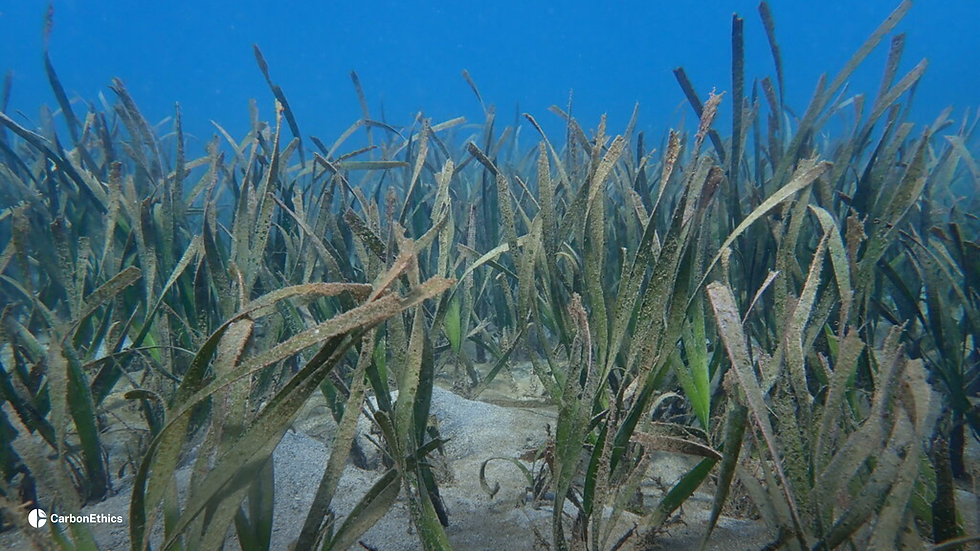
The ecological value of seagrass is multi-layered. In coastal environments, seagrass meadows store blue carbon, reduce wave energy, stabilise sediments, and help control coastal erosion. For people and their economies, seagrass supports fisheries, livelihoods, and biodiversity conservation while also improving water quality. Seagrass meadows can serve as nurseries that shelter juvenile fish and invertebrates during vulnerable life stages, thereby boosting their survival and strengthening fisheries productivity.
However, seagrass meadows cover less than 0.2% of the world’s oceans, yet are declining by approximately 7% each year. In Indonesia, reported declines range from 2% to 5% per year. This degradation is largely driven by human pressures, including coastal development, land reclamation, and pollution, and is exacerbated by climate-related stressors.
This decline is concerning because seagrass is vulnerable and its restoration is challenging. Seagrass is sensitive and generally harder to cultivate than many other coastal ecosystems, largely because it lives where currents and waves can dislodge or damage newly planted shoots. Thus, the planting window must be chosen carefully, and site conditions must be appropriate from the start. Because seagrass depends on sunlight for photosynthesis, poor water quality and high turbidity can hinder growth and prevent the development of stable root–rhizome anchoring.
Seagrass Cultivation and Restoration Methods
Cultivating and restoring seagrass generally follows two primary approaches: reseeding and transplanting. Reseeding focuses on collecting wild seeds and redistributing them to targeted restoration sites, either directly or through nursery-based seedlings. In addition, it could be through transplanting or replanting, which moves seagrass plants from donor areas to restoration sites.
Direct seeding is relatively simple to implement but depends heavily on seed availability and often faces low survival because seeds can be dispersed by currents or lost to disturbances. Meanwhile, nursery-based seedlings are grown and strengthened under controlled nursery conditions before being returned to the ocean, increasing their survival rate.
Seagrass restoration depends on stable environmental conditions, yet coastal waters are often highly dynamic, which could threaten early seedling survival. Establishing a nursery system is therefore a strategic approach to improve restoration success. By preparing, germinating, and selecting seedlings under controlled conditions, nurseries produce stronger, more resilient planting material. As a result, transplanted seagrass has a greater capacity to withstand environmental instability and achieve higher survival and growth rates in natural waters.
CarbonEthics and PELNI Launched Seagrass Greenhouse Lab in Bintan, Kepulauan Riau
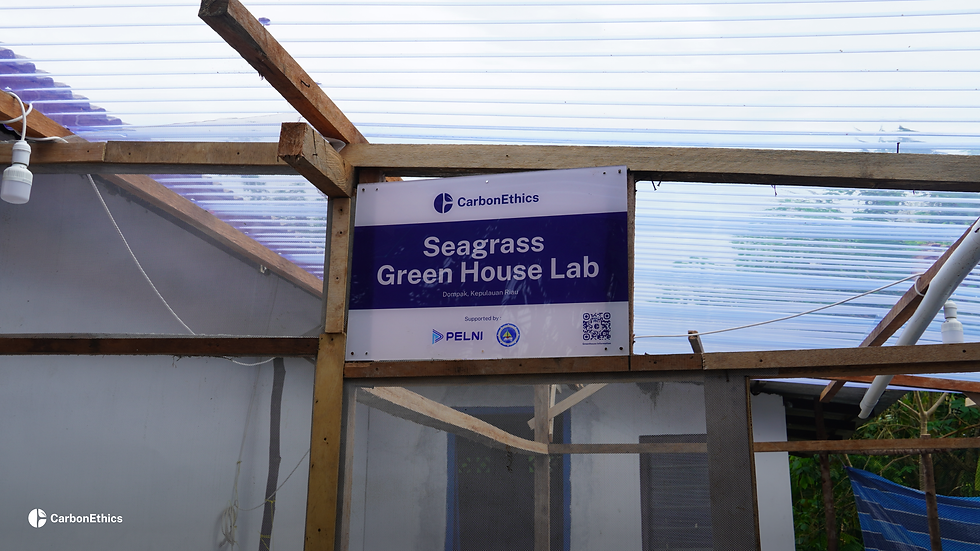
The establishment of the Seagrass Greenhouse Lab by CarbonEthics, in collaboration with PELNI, aims to support more sustained seagrass restoration efforts. Designed for cultivation, Seagrass Greenhouse Lab in Bintan nurtures seagrass in a controlled environment before it is restored to the ocean, increasing the survival rate of cultivated seeds.
The first phase of our Seagrass Greenhouse Lab has cultivated 1,000 seedlings and empowered 25 local beneficiaries. To ensure long-term sustainability, we also provide community training in cultivation practices, nursery greenhouse development, and monitoring. The lab is designed as a shared space where researchers, practitioners, and coastal communities can collaborate and learn from one another to restore seagrass ecosystems that support coastal livelihoods and marine life.
Seagrass restoration through the Seagrass Greenhouse Lab is a practical climate solution. Healthy seagrass meadows can strengthen blue carbon ecosystems by storing carbon beneath the seabed and contributing to long-term climate mitigation. At the same time, support fisheries and other coastal livelihoods, linking ecological resilience with economic sustainability as part of a broader blue economy.
Learn how you can start your blue carbon restoration journey at carbonethics.co/our-projects.
About CarbonEthics
CarbonEthics is a tech-enabled Ecosystem Restoration Company specializing in carbon project development and blue carbon ecosystems. We bridge ecosystem restoration, climate finance, and regulatory expertise to deliver high-integrity carbon solutions that create real impact for local communities while preserving biodiversity.


Lotería Nacional suele generar curiosidad entre quienes siguen regularmente los sorteos. Me pareció interesante que este artículo presente la información de forma clara y accesible. Tener los datos organizados facilita la consulta, permite revisar diferentes combinaciones y ayuda al lector a encontrar rápidamente aquello que desea comprobar después de conocer las novedades de una jornada.
I like how Escape Road gets harder without making the controls unnecessarily complicated. https://www.majescogames.com/
I noticed jalwa-game.io while searching for information about an online gaming website. When visiting any domain, I think users should first verify that the address is correct and secure. It is also useful to review the site’s policies, account information, and available support options. Visitors should avoid entering sensitive credentials on pages that look suspicious or different from the expected website.
Great initiative by CarbonEthics and PELNI! The Seagrass Greenhouse Lab in Bintan is a smart approach to tackling seagrass restoration challenges. I found this while exploring Blocky Xtreme, where I usually enjoy motocross rides, but articles like this remind me how important real-world environmental solutions are too.
I visited the Jalwa Game website and found the content fairly comprehensive. The game, APK, login, and registration sections cover many common topics, while the FAQ section adds extra convenience. I think the website could improve by clearly distinguishing current information from older content, particularly when discussing bonuses, rewards, offers, or other features that may change. Bonus