
Carbon Talk: What MoF Regulation 6/2026 Means for Indonesia’s Forest Carbon Market and Social Forestry Projects


The issuance of Ministry of Forestry Regulation No. 6 of 2026 (MoF Regulation 6/2026) marks a new milestone for Indonesia’s forestry carbon market, including social forestry-based projects. The regulation introduces clearer direction for the country’s carbon market ecosystem while strengthening governance frameworks for community-based forest carbon project development.
On 12 May 2026, Carbon Talk brought together policymakers, project developers, sustainability practitioners, and carbon market stakeholders to discuss the implications of MoF Regulation 6/2026 for Indonesia’s forest carbon sector and the future development of social forestry-based carbon projects.
The forum was organized by Carbon Policy Lab (CPL) — a joint policy advocacy initiative between CarbonEthics and NatureVerse — in collaboration with Georgetown SFS Asia Pacific. The discussion brought together representatives from the Ministry of Forestry, the National Economic Value of Carbon (NEK) Steering Committee, Verra, and Konservasi Indonesia to discuss implementation readiness on the ground.
The discussion featured perspectives from Bimo Soewadji (Co-Founder & CEO, CarbonEthics), Iwan Wibisono (NCS Lead, Konservasi Indonesia), Ilham, ST, MT (Director of Forest Utilization Business Development, Ministry of Forestry), Win Sim Tan (Regional Representative of Asia and the Pacific, Verra), James Askew (Chief Development Officer, NatureVerse), and Fajar Nuradi, S.S., MPP (Deputy Assistant for Food Production and Climate Change, Coordinating Ministry for Food Affairs of the Republic of Indonesia; National Economic Value of Carbon (NEK) Steering Committee).
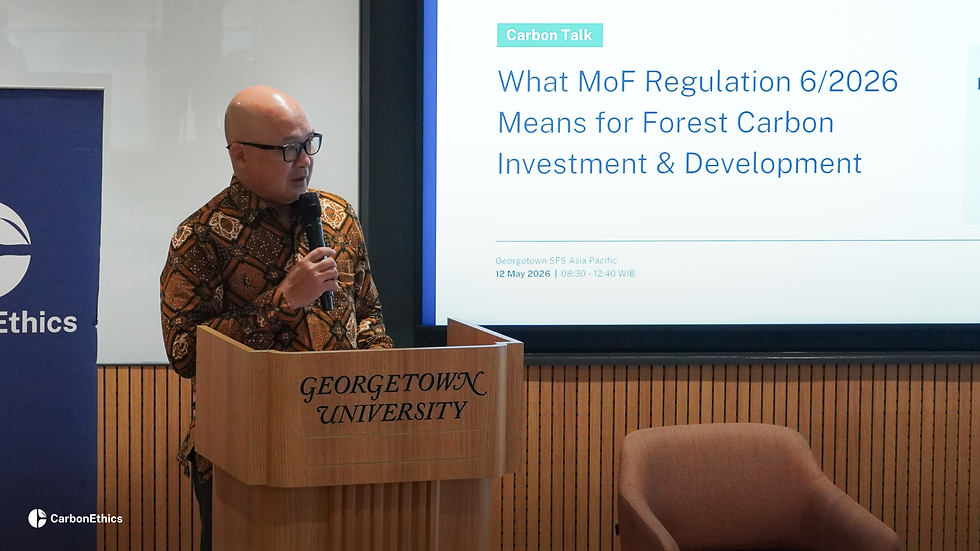
One of the most significant shifts highlighted during the discussion was the greater operational clarity introduced for social forestry groups and customary law communities participating in carbon markets. MoF Regulation 6/2026 introduces clearer pathways and review timelines for carbon unit issuance and registration under the national Carbon Unit Registry System (SRUK).
Importantly, the regulation also introduces a transition mechanism allowing projects to continue progressing through the Ministry of Forestry’s electronic system while SRUK is being finalized, providing business actors with a clearer route to develop and register projects from the outset.
The regulation further reinforces safeguards related to benefit-sharing, accountability, and Free, Prior, and Informed Consent (FPIC), while requiring projects involving communities to work with registered partners. These provisions strengthen governance, social safeguards, and the long-term credibility of carbon credits generated through community-based forest carbon projects.

During the discussion, Bimo Soewadji, Co-Founder & CEO of CarbonEthics, shared how Article 6 of MoF Regulation 6/2026 may create opportunities for social forestry projects to become more investment-ready while strengthening community participation within carbon project development.
“This provision opens opportunities for local communities to participate in the carbon market, while also providing access for investors and buyers who seek to participate in inclusive projects that have deeper involvement in local community economic activities and empower them to become the actor of the carbon project, not only as the beneficiaries.”

As Indonesia’s carbon market ecosystem continues to evolve, discussions around governance, safeguards, implementation readiness, and community participation remain important in supporting credible and long-term climate solutions.
As a follow-up to the forum, Carbon Policy Lab will prepare a practitioner brief to be submitted to the Ministry of Forestry and the Secretariat of the National Economic Value of Carbon Steering Committee to support the refinement of ongoing implementation guidelines.
Explore our legal update on MoF Regulation 6/2026: https://www.carbonethics.co/recent-publication Watch our full Carbon Talk:
About CarbonEthics
CarbonEthics is a tech-enabled Ecosystem Restoration Company specializing in carbon project development and blue carbon ecosystems. We bridge ecosystem restoration, climate finance, and regulatory expertise to deliver high-integrity carbon solutions that create real impact for local communities while preserving biodiversity.


Really interesting session on MoF Regulation 6/2026 and how it shapes Indonesia’s carbon market and social forestry projects—makes me think about planning strategies, kind of like checking out a Last War guide for tips before a big mission.
I appreciate the practical information in this discussion. Knowing how router administration works can help users understand their local network and handle basic configuration tasks. If someone searches for 192.268.18.1, checking every number carefully can prevent confusion caused by an incorrectly entered address.
The new MoF Regulation 6/2026 brings clearer pathways for Indonesia’s forest carbon market, especially for social forestry projects and community participation. It’s an important step toward stronger governance and transparent carbon development. For Minecraft players, practical optimization resources are also available at Minecraft Optifines.
For developers who need an AI assistant that doesn't hog resources, this project seems well-suited. The sub-10MB memory footprint and sub-second startup are standout features, especially for edge devices or servers with limited RAM. The integration with multiple messaging platforms means you can use it where you already communicate. I found the performance-first approach refreshing, and the ultra-lightweight assistant details are worth reading for those with similar priorities.
This is an interesting development for Indonesia’s forest carbon market. Clear regulations can help improve transparency, project accountability, and community participation in social forestry. The focus on stronger governance and benefit-sharing is especially important for building trust in carbon projects over the long term قطار الحرمين السريع.